
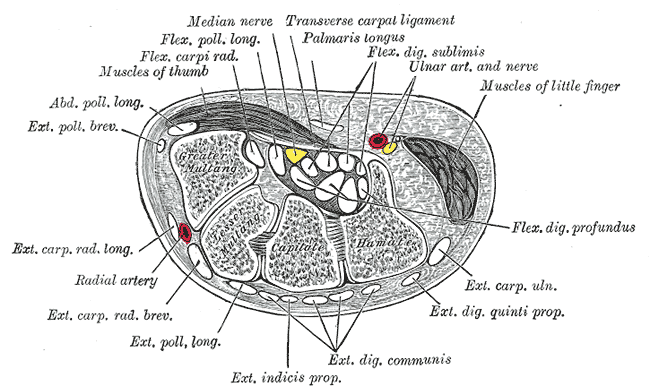
 It affects mainly older individuals, and is associated with obesity, hypothyroidism, diabetes, pregnancy, family history, rheumatoid arthritis, and wrist shape. In spite of common feelings otherwise, there is very limited relation between work-related repetitive motion and carpal tunnel syndrome. The cause of the syndrome is a compression of the carpal tunnel, causing an impingement on the median nerve of the wrist. This causes pain or numbness in the fingers and thumb. The carpal tunnel release procedure involves reducing this impingement by cutting the carpal ligament. Then, after removing any enlarged tissue surrounding the median nerve, the carpal ligament is lengthened and reattached. The surgery is done on an outpatient basis and usually usually takes about a week of rest before beginning a rehabilitation program to regain muscle control. Results are usually very good, with complete reduction of pain and full mobility retained. This is one of the most common procedures performed by orthopedic surgeons in the United States.
Showing posts with label surgery. Show all posts
Showing posts with label surgery. Show all posts
4/3/09
Procedure Profile: Carpal Tunnel Release
Carpal tunnel syndrome is fairly common in our population today.  It affects mainly older individuals, and is associated with obesity, hypothyroidism, diabetes, pregnancy, family history, rheumatoid arthritis, and wrist shape. In spite of common feelings otherwise, there is very limited relation between work-related repetitive motion and carpal tunnel syndrome. The cause of the syndrome is a compression of the carpal tunnel, causing an impingement on the median nerve of the wrist. This causes pain or numbness in the fingers and thumb. The carpal tunnel release procedure involves reducing this impingement by cutting the carpal ligament. Then, after removing any enlarged tissue surrounding the median nerve, the carpal ligament is lengthened and reattached. The surgery is done on an outpatient basis and usually usually takes about a week of rest before beginning a rehabilitation program to regain muscle control. Results are usually very good, with complete reduction of pain and full mobility retained. This is one of the most common procedures performed by orthopedic surgeons in the United States.
It affects mainly older individuals, and is associated with obesity, hypothyroidism, diabetes, pregnancy, family history, rheumatoid arthritis, and wrist shape. In spite of common feelings otherwise, there is very limited relation between work-related repetitive motion and carpal tunnel syndrome. The cause of the syndrome is a compression of the carpal tunnel, causing an impingement on the median nerve of the wrist. This causes pain or numbness in the fingers and thumb. The carpal tunnel release procedure involves reducing this impingement by cutting the carpal ligament. Then, after removing any enlarged tissue surrounding the median nerve, the carpal ligament is lengthened and reattached. The surgery is done on an outpatient basis and usually usually takes about a week of rest before beginning a rehabilitation program to regain muscle control. Results are usually very good, with complete reduction of pain and full mobility retained. This is one of the most common procedures performed by orthopedic surgeons in the United States.


4/1/09
Tendon Transfer Surgery - Ingenuity solves life's most difficult situations
This post is related more directly to the surgery aspect of my blog, as opposed to the most recent posts which had been more concerned with aging and frailty.  As mentioned in the title, I would like to cover the procedure of tendon transfer surgery. Just as the name implies, it involves the relocation of a tendon from one muscle to a bone that was previously moved by another muscle. This is practical to do for a quadriplegic patient who has retained movement of the shoulders but has lost control of the arms and hands. This situation is fairly common as the nerves running to the shoulder do not pass through the spinal cord with the rest of the nerves or the lower body. Therefore, an injury even to the highest level of the spinal cord frequently spares the shoulder nerves. Thus, the controllable trapezius muscle is partially removed from the shoulder and reattached lower on the arm or in the hand or thumb to provide either wrist movement, arm movement, or pinching ability. While the possibilities for transplant are limited, the results are a gift for those who receive the surgery. Quality of life goes up dramatically due to increased independence. This procedure is amazing in it's inherent simplicity (just move the attachment point of a muscle to provide a new function) and there is true beauty in its outcome.
 As mentioned in the title, I would like to cover the procedure of tendon transfer surgery. Just as the name implies, it involves the relocation of a tendon from one muscle to a bone that was previously moved by another muscle. This is practical to do for a quadriplegic patient who has retained movement of the shoulders but has lost control of the arms and hands. This situation is fairly common as the nerves running to the shoulder do not pass through the spinal cord with the rest of the nerves or the lower body. Therefore, an injury even to the highest level of the spinal cord frequently spares the shoulder nerves. Thus, the controllable trapezius muscle is partially removed from the shoulder and reattached lower on the arm or in the hand or thumb to provide either wrist movement, arm movement, or pinching ability. While the possibilities for transplant are limited, the results are a gift for those who receive the surgery. Quality of life goes up dramatically due to increased independence. This procedure is amazing in it's inherent simplicity (just move the attachment point of a muscle to provide a new function) and there is true beauty in its outcome.
4/8/08
Quad-Sparing Knee Replacement Surgery: The New Gold Standard
All aspects of surgery are being affected by a new minimally invasive trend. No matter what procedure is being performed, if there is a way to do it with less negative impact on the body, today’s surgeons are working on ways to make it happen. A few weeks ago I wrote a post about the mini hip replacement that has developed recently. This week I will write a similar post about a relatively new procedure known as a quadriceps-sparing total knee replacement. It has the same end result as a traditional total knee replacement, or TKR, but it does so with considerably less damage to the surrounding tissue in the operating room. I believe that this new procedure, unlike the total hip replacement, is a great improvement on the traditional surgery. While it is a more difficult operation when compared to the traditional TKR, its advantages are more than just cosmetic and I believe it is a superior choice for all people looking for a knee replacement.
During a traditional knee replacement surgery, a vertical incision is made along the top of the knee that exposes the quadriceps muscle. A secondary incision is then made through the quadriceps to expose the knee joint. At this stage, many tendons and much muscle tissue has been cut, resulting in unavoidable blood loss and a need for major anesthesia. The knee prosthesis is then inserted by a method similar to the total hip replacement. A plastic cup is placed on one end of the joint and a metal ball is attached to the other, as can be seen in the x-ray at left. The new joint is then assembled and aligned and tested for mobility. Once the surgeon is satisfied with the functionality of the prosthesis the soft tissue is sutured and the incisions are closed. Traditional knee replacement patients will typically stay in the hospital for three to four days, and then have up to eight weeks of physical therapy to recover completely.
This is the area in which the quad-sparing procedure becomes most attractive. Patients who undergo this surgery can expect to leave the hospital in less than one day, and the reasons are multi-fold. First of all, the incision is much smaller. In the traditional surgery, the incision is approximately eight to twelve inches in length. With the new technique it can be as small as three inches, with most being about four (see image below right). The incision is made on the side of the knee, which allows the joint to be exposed without severing any tendons or disturbing much muscle tissue. Because of this, there is less blood loss compared to the traditional TKR and less anesthesia is needed. Less anesthesia is almost always preferred by surgeons since surgery itself is a very traumatic experience for the body and heavy sedation only complicates the recovery process.
After the surgery is complete, the patient can usually be walking around as soon as he/she wakes up. Since there is no major structural trauma caused by the surgery, the road to recovery is a very quick one. The success rate is astounding. Take this study done by Rush University Medical Center, for example. In their trial run of fifty patients, ninety-six percent were able to go home the same day as their surgery. Granted, each patient was the first one treated that day (allowing maximum same-day recovery time), but it is still quite impressive. Additionally, all patients were required to pass an inspection before discharge. A patient was deemed fit to go home if he/she could get out of bed unassisted, stand up from a sitting position, walk 100 feet, and ascend and descend a full flight of stairs. When one considers the fact that these patients were able to perform these basic actions on the very day that they had a total knee replacement surgery, it is really quite remarkable.
As for the long-term reliability of this procedure, only time will tell. It has still been less than five years since the first one was performed, so longevity has not yet come into play. There is the obvious concern that the prosthesis may not be properly aligned in the quad-sparing method due to a lack of direct visual confirmation during surgery. However, unlike in the mini hip replacement, I feel that there are enough alignment tools available to the surgeon to confirm a good placement without the need for a direct line of sight. While the alignment process may take longer with the quad-sparing method due to a need for x-rays in the operating room, the whole procedure takes the same time. Both techniques take about two hours to complete, although prep time may be longer for the quad-sparing method.
As I said earlier, I think that the quad-sparing method is going to become the new standard for knee replacement. Since the quadriceps is the dominant muscle responsible for stabilizing the knee, it makes perfect sense that it should be preserved rather than aggravated during surgery. As surgical imaging advances in the future, it will only become easier for this surgery to be performed with the same kind of accuracy associated with the traditional method. I look at this as great news for the millions of Americans who are aging and becoming candidates for knee replacement surgery. Knowing that the recovery will be so quick will surely make it a less stressful experience.
During a traditional knee replacement surgery, a vertical incision is made along the top of the knee that exposes the quadriceps muscle. A secondary incision is then made through the quadriceps to expose the knee joint.
At this stage, many tendons and much muscle tissue has been cut, resulting in unavoidable blood loss and a need for major anesthesia. The knee prosthesis is then inserted by a method similar to the total hip replacement. A plastic cup is placed on one end of the joint and a metal ball is attached to the other, as can be seen in the x-ray at left. The new joint is then assembled and aligned and tested for mobility. Once the surgeon is satisfied with the functionality of the prosthesis the soft tissue is sutured and the incisions are closed. Traditional knee replacement patients will typically stay in the hospital for three to four days, and then have up to eight weeks of physical therapy to recover completely.This is the area in which the quad-sparing procedure becomes most attractive. Patients who undergo this surgery can expect to leave the hospital in less than one day, and the reasons are multi-fold. First of all, the incision is much smaller. In the traditional surgery, the incision is approximately eight to twelve inches in length. With the new technique it can be as small as three inches, with most being about four (see image below right). The incision is made on the side of the knee, which allows the joint to be exposed without severing any tendons or disturbing much muscle tissue. Because of this, there is less blood loss compared to the traditional TKR and less anesthesia is needed. Less anesthesia is almost always preferred by surgeons since surgery itself is a very traumatic experience for the body and heavy sedation only complicates the recovery process.
After the surgery is complete, the patient can usually be walking around as soon as he/she wakes up. Since there is no major structural trauma caused by the surgery, the road to recovery is a very quick one. The success rate is astounding. Take this study done by Rush University Medical Center, for example.
In their trial run of fifty patients, ninety-six percent were able to go home the same day as their surgery. Granted, each patient was the first one treated that day (allowing maximum same-day recovery time), but it is still quite impressive. Additionally, all patients were required to pass an inspection before discharge. A patient was deemed fit to go home if he/she could get out of bed unassisted, stand up from a sitting position, walk 100 feet, and ascend and descend a full flight of stairs. When one considers the fact that these patients were able to perform these basic actions on the very day that they had a total knee replacement surgery, it is really quite remarkable.As for the long-term reliability of this procedure, only time will tell. It has still been less than five years since the first one was performed, so longevity has not yet come into play. There is the obvious concern that the prosthesis may not be properly aligned in the quad-sparing method due to a lack of direct visual confirmation during surgery. However, unlike in the mini hip replacement, I feel that there are enough alignment tools available to the surgeon to confirm a good placement without the need for a direct line of sight. While the alignment process may take longer with the quad-sparing method due to a need for x-rays in the operating room, the whole procedure takes the same time. Both techniques take about two hours to complete, although prep time may be longer for the quad-sparing method.
As I said earlier, I think that the quad-sparing method is going to become the new standard for knee replacement. Since the quadriceps is the dominant muscle responsible for stabilizing the knee, it makes perfect sense that it should be preserved rather than aggravated during surgery. As surgical imaging advances in the future, it will only become easier for this surgery to be performed with the same kind of accuracy associated with the traditional method. I look at this as great news for the millions of Americans who are aging and becoming candidates for knee replacement surgery. Knowing that the recovery will be so quick will surely make it a less stressful experience.
3/10/08
Total or Mini: Will a New Hip Replacement Technique Take Over?
As I mentioned I would in my previous post, this week I used my linkroll to find a topic on which to write. What I found was quite interesting. There is a new orthopedic procedure for hip replacement known as a mini, or minimally invasive hip replacement. This is an alternative to the standard total hip replacement. The intriguing thing about this new procedure is that the surgeons performing it claim to be able to create the same end result as a traditional open hip replacement without the long hospital stay associated with such an operation. I feel that this is simply not the case. While it is true that the recovery time is shorter for patients who undergo the mini hip replacement, there are greater risks for long-term complications that negate any initial benefits of the less-invasive surgery.
The total hip replacement procedure is one of the oldest and most successful orthopedic operations performed today. No other joint can be replaced as easily or completely as the hip. The procedure is performed exactly the way it sounds. The entire hip joint is removed from its socket and sawn off of the top of the femur. An artificial prosthesis (image to the right) is then inserted into the core of the femur and locked into place with methyl methacrylate, a bony cement. Younger or more physically demanding patients can chose a cementless prosthesis which fuses naturally to the bone. Cementless prostheses have micropores that the femur can grow into and create a strong permanent bond. The other end of the prosthesis is inserted into an artificial cup that is placed within the socket of the existing joint in the pelvis.
There are several options for the material and design of the replacement hip. One common pairing is a metal and plastic combination wherein the replacement socket is plastic and the ball joint is metal. Stainless steel is often chosen for its low reactivity, although some patients opt for titanium instead. A newer option is a ceramic prosthesis, although these have not been around long enough to prove their longevity. They have a high standard to meet, though. Traditional total hip replacement with a stainless steel and plastic prosthesis can be expected to last well over twenty years. Eighty percent of all replacements last longer than twenty years, and over half last longer than thirty. Of course, the younger a patient is, the more physically demanding they will be on it and the longer they will need it to last. This is an inherent flaw in the process of joint replacement that can only be solved through the eventual replacement of the replaced joint. A second replacement is known as a revision hip replacement. Revisions do not last as long as the initial replacement, but it is rare for a patient to need more than one revision.
This is due to the fact that a typical candidate for total hip replacement surgery is older (above the age of fifty) with oste oarthritis of the hip. Osteoarthritis is caused by normal wear and tear on the joint as a component of the aging process, and is detailed in the image at left. In this common form of arthritis, the cartilage separating the two bones wears away and leaves the bones to rub against each other. This can be very painful and in some cases will render the joint immobile. Men around the age of forty-five begin to become candidates for osteoarthritis, and women catch up by around age fifty-five. With this in mind, it is easy to see how pretty much anyone could find themselves in need of a hip replacement at some point in their life. According to the Central Ohio Orthopedics Center, Over 166,000 hip replacements are done annually in the United States, with more than one third of those going to patients below the age of sixty-five.
Given that so many patients are elderly, it is imperative that infection and post-operative complications be kept to a minimum. This is where the mini hip replacement comes in. In the traditional surgery, a relatively large incision is made either posterior, lateral or anterior to the joint. This incision is made large enough to allow the surgeon full access to the joint and the surrounding muscle, tendons, and ligaments. With the entire area in full view, replacement and alignment is a fairly straightforward process. The mini hip replacement, on the other hand, involves two smaller incisions. One of these incisions is made posterior to the joint and the other is lateral. These smaller incisions reduce the risk of infection by limiting the amount of exposure to everything outside of the body. With the two access points it is possible for the surgeon to remove the deteriorated joint, insert the prosthesis, and cement it in place without ever actually seeing what is going on directly. Instead, x-rays and cameras help with the alignment of the prosthesis within the body.
As one can imagine, this is a difficult procedure. In spite of the fact that patients who undergo a mini hip replacement can be walking again the next day, not many surgeons are performing it because it is so much more difficult than the open procedure. Since the surgery itself is more difficult, there is a greater chance for error on behalf of the surgeon. These mistakes usually appear minor, such as a slight misalignment of the prosthesis, but they can lead to larger consequences later. Mini hip replacement recipients are at a greater risk for prosthesis dislocation than total hip replacement recipients. Dislocation of a prosthesis is a very serious problem that can only be corrected by a revision replacement.
From what I have read in the available literature, it seems to me that the mini hip replacement is not yet ready to completely replace the full hip replacement. The benefits of the mini procedure do not outweigh the possible consequences of a surgical mistake. After all, what good does it do to get out of the hospital a few days sooner if you may be setting yourself up for a revision ten years sooner? I cannot say that there is no hope for this new technique though. In the future, surgeons may very well become more proficient at the mini procedure. When they do it will be an excellent alternative for someone who needs a hip replacement but due to poor health cannot risk an open procedure.
The total hip replacement procedure is one of the oldest and most successful orthopedic operations performed today. No other joint can be replaced as easily or completely as the hip. The procedure is performed exactly the way it sounds.
The entire hip joint is removed from its socket and sawn off of the top of the femur. An artificial prosthesis (image to the right) is then inserted into the core of the femur and locked into place with methyl methacrylate, a bony cement. Younger or more physically demanding patients can chose a cementless prosthesis which fuses naturally to the bone. Cementless prostheses have micropores that the femur can grow into and create a strong permanent bond. The other end of the prosthesis is inserted into an artificial cup that is placed within the socket of the existing joint in the pelvis.There are several options for the material and design of the replacement hip. One common pairing is a metal and plastic combination wherein the replacement socket is plastic and the ball joint is metal. Stainless steel is often chosen for its low reactivity, although some patients opt for titanium instead. A newer option is a ceramic prosthesis, although these have not been around long enough to prove their longevity. They have a high standard to meet, though. Traditional total hip replacement with a stainless steel and plastic prosthesis can be expected to last well over twenty years. Eighty percent of all replacements last longer than twenty years, and over half last longer than thirty. Of course, the younger a patient is, the more physically demanding they will be on it and the longer they will need it to last. This is an inherent flaw in the process of joint replacement that can only be solved through the eventual replacement of the replaced joint. A second replacement is known as a revision hip replacement. Revisions do not last as long as the initial replacement, but it is rare for a patient to need more than one revision.
This is due to the fact that a typical candidate for total hip replacement surgery is older (above the age of fifty) with oste
oarthritis of the hip. Osteoarthritis is caused by normal wear and tear on the joint as a component of the aging process, and is detailed in the image at left. In this common form of arthritis, the cartilage separating the two bones wears away and leaves the bones to rub against each other. This can be very painful and in some cases will render the joint immobile. Men around the age of forty-five begin to become candidates for osteoarthritis, and women catch up by around age fifty-five. With this in mind, it is easy to see how pretty much anyone could find themselves in need of a hip replacement at some point in their life. According to the Central Ohio Orthopedics Center, Over 166,000 hip replacements are done annually in the United States, with more than one third of those going to patients below the age of sixty-five.Given that so many patients are elderly, it is imperative that infection and post-operative complications be kept to a minimum. This is where the mini hip replacement comes in. In the traditional surgery, a relatively large incision is made either posterior, lateral or anterior to the joint. This incision is made large enough to allow the surgeon full access to the joint and the surrounding muscle, tendons, and ligaments. With the entire area in full view, replacement and alignment is a fairly straightforward process. The mini hip replacement, on the other hand, involves two smaller incisions. One of these incisions is made posterior to the joint and the other is lateral. These smaller incisions reduce the risk of infection by limiting the amount of exposure to everything outside of the body. With the two access points it is possible for the surgeon to remove the deteriorated joint, insert the prosthesis, and cement it in place without ever actually seeing what is going on directly. Instead, x-rays and cameras help with the alignment of the prosthesis within the body.
As one can imagine, this is a difficult procedure. In spite of the fact that patients who undergo a mini hip replacement can be walking again the next day, not many surgeons are performing it because it is so much more difficult than the open procedure. Since the surgery itself is more difficult, there is a greater chance for error on behalf of the surgeon. These mistakes usually appear minor, such as a slight misalignment of the prosthesis, but they can lead to larger consequences later. Mini hip replacement recipients are at a greater risk for prosthesis dislocation than total hip replacement recipients. Dislocation of a prosthesis is a very serious problem that can only be corrected by a revision replacement.
From what I have read in the available literature, it seems to me that the mini hip replacement is not yet ready to completely replace the full hip replacement. The benefits of the mini procedure do not outweigh the possible consequences of a surgical mistake. After all, what good does it do to get out of the hospital a few days sooner if you may be setting yourself up for a revision ten years sooner? I cannot say that there is no hope for this new technique though. In the future, surgeons may very well become more proficient at the mini procedure. When they do it will be an excellent alternative for someone who needs a hip replacement but due to poor health cannot risk an open procedure.
Subscribe to:
Posts (Atom)
